

Class of 1956
Jim Ross Lightfoot
James Ross Lightfoot
Born: September 27, 1938 at the Florence Crittendon Home for Unwed Mothers
in Sioux City, Iowa
Adoptive parents
Elmer Ross Lightfoot
January 25, 1911 – December 14, 2001
Altha (Daughters) Lightfoot
Jan 19, 1913 – October 24, 1997
Farragut High School – Class of 1956
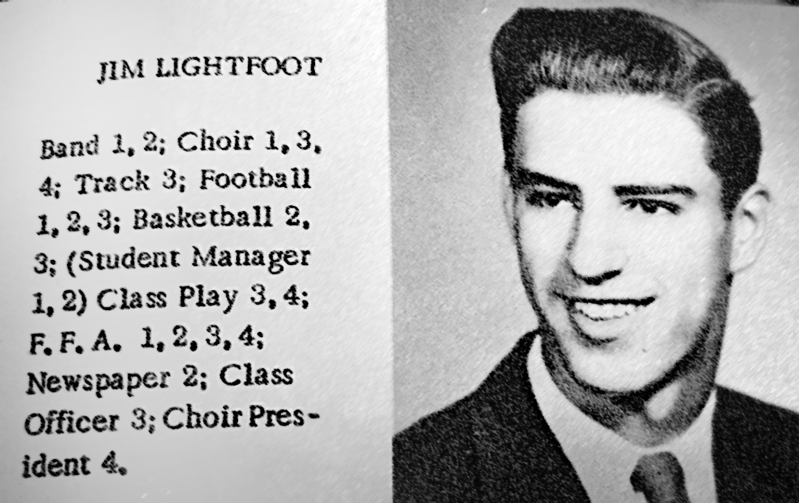
Jim recalls fond memories of his character-building experiences gained through activities and personal relationships while attending school in Farragut. He gives specific mention to faculty members:
Orin Mann; Lyle Latimer; Dale Hackett; Harold Penwell; Eva Penwell; Cecile Cox; William Miller; Mildred Warner; Zoe Young; Loree Hogsett; Wayne Maddocks; Clarence Godbey; Genevieve Larch; Charles Steinhoff.
Military Service
Jim was a member of the US Army Active Reserve during the period 1956-1970.
After graduation from high school, he spent six months on active duty while he completed basic infantry training at Ft Leonard Wood, MO and advanced training at Ft Knox, KY. During his military service, Jim served as Primary Instructor for the 105 mm Recoilless Rifle and then Fixed-wing Aircraft Maintenance.
1957-1960 Jim worked at IBM, first in Omaha and then in Tulsa, OK
1959-1961 Jim served as an officer with the Tulsa Police Department
Jim’s start in radio came as a result of his friendship with Jim Hartz (later became host of the Today Show) and Milt Haynes (CBS overseas reporter), who both worked at KRMG Radio in Tulsa, OK, when Jim was a police officer there.
Radio career
1961-1963 – KSSS in Colorado Springs, CO
1963-1967 – KMA in Shenandoah, IA
1967-1967 (8 months) – KFNF in Shenandoah, IA
1967-1970 – KMA in Shenandoah, IA
1976-1984 – KMA in Shenandoah, IA
Jim shared his personality and his voice over the radio waves for 19 years.
(5 years as a DJ – Announcer and 14 years as Associate Farm Director)
Why did he use Ross and not Lightfoot as his “radio name” ?
When he began his KMA career, Dean Navin was the Program Director and the Farm Director was Merril Langfeyette. Dean felt Langfeyette and Lightfoot sounded too much alike and would be confusing. Using your middle-name for your last name was common practice in radio, so my middle name Ross replaced Lightfoot.
Sidney Rodeo
Rodeo was part of my life starting in my early teens.
Some personal highlights include interviews and interactions with many “stars”.
Sitting with country singer Lynn Anderson in the Tall Corn Motel discussing where her career should go, who could help, etc. Great times and interviews with Doc and Festus. He became good friends with Ken Curtis (Festus) and they exchanged Christmas cards, etc. He appeared on the Stoney Burke Show as the announcer and got paid a whopping $250 by Daystar Productions. Jim shares that Jack Lord, who played Stoney Burke, was an absolute X@*& and the complete opposite of the great people of the crew on Bonanza. Jerry Reed was, well, Jerry Reed…quite a character.
The Sidney Rodeo committee was a wonderful group of men. One year Jim enjoyed a trip with them to Denver for the annual meeting of the Rodeo Cowboys Association (RCA). Jim treasures his “semi-truckload” of good memories from the Sidney Rodeo.
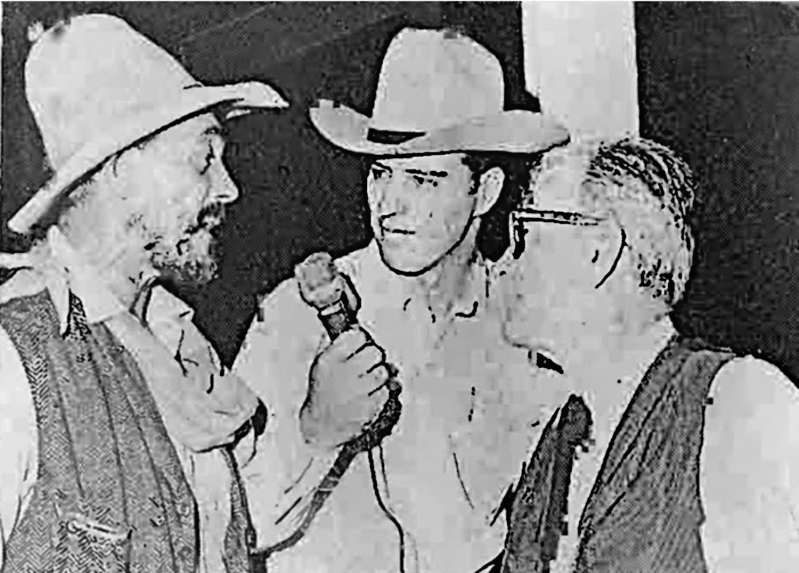
Jim ‘Ross’ Lightfoot interviewing “Gunsmoke” co-stars Festus Haggen (Ken Curtis) and Dr. Galen Adams (Milburn Stone) during the 1968 Sidney Rodeo
During 1970-1976, Jim worked at Farmaster, Inc., in Corsicana, TX where he built and then managed a manufacturing and sales operation. In 1976 the company was sold to the Wickes Corporation in California.
During his time at Farmaster, he was a member of the Corsicana City Council. One day, Nancy Harrison, manager at KCIR radio, visited the Farmaster plant to interview Jim.
The interview went well – Jim and Nancy were married on May 14, 1976.
In 1976, Jim and Nancy moved back to Shenandoah and Jim returned to KMA.
For those who remember enjoying ice cream cones in Shenandoah, Jim and Nancy owned the Zesto during the period 1976-1981.
(The Zesto was located on the south side of Sheridan Ave and east side of N. Railroad St – straight south of the Depot Restaurant & Lounge)
1985 – 1997 Served six terms in the United States Congress representing the citizens of Iowa’s 5th and 3rdCongressional Districts
1998 – 2012 Vice-President, Forensic Technology, Inc. (FTI), Montreal, Canada
(Washington, DC office)
FTI performed ballistic forensic work for law enforcement. The Integrated Ballistic Identification System (IBIS) was in its infancy in 1998 when Jim joined the company. He enjoyed the opportunity to contribute to the foundational creation of IBIS which is now in use in 88 countries and is the Gold Standard in ballistic forensics.
Retired in 2018 after 14 years with FTI, Inc.
Author
Two books are currently in print with a third due for release in late summer 2026. Climbing Mountains with God is a memoir of my twelve years in Congress. Tracks in the Brass is a fictional murder mystery based on real, not imaginary law enforcement officers. Book was fact-checked by a group of senior law enforcement officers, including a former Director of the United States Secret Service (USSS) and The Bureau of Alcohol, Tobacco, Firearms, and Explosives (ATF). Silenced Evil is the second in a series and continues the adventures of Detective Roger Blair.
All are available on Amazon.com
Children include:
Terri, Jamie, Allison, and Jim, Jr.
In retirement, Jim and Nancy settled in White Oak, TX, where they celebrated their 50th wedding anniversary on May 14, 2026.
The National Association of Farm Broadcasting (NAFB) is a professional organization that represents, supports, and promotes the success of farm broadcasters across the United States. NAFB works to ensure farm broadcasting continues to be recognized as a vital part of the agricultural community by delivering trusted agricultural news and information to farmers, ranchers, and rural audiences.

Sep 30, 2018
Jim Ross Lightfoot (NAFB Emeritus Member, White Oak, TX) asks and answers his own question, “What do old farm broadcasters do when they’ve read their last market report and filed their last story? Reminisce! Yes, we old timers do a lot of that.” Jim says he was very fortunate to have started his career in farm broadcasting with an excellent broadcaster by the name of Jack Gowing. “Jack was a great mentor, and he taught me many things that I still use today.
In those days the major livestock yards were operating in places like Omaha and Chicago. Between the American Royal Stock Show in Kansas City, Denver Stock Show, Chicago Stock Show and others, we had plenty to do. Of course, covering these events was in addition to our regular broadcasting where we did our best to provide producers information of interest and relevance to their operation.” From 1970 until 1976, Jim took a hiatus from KMA (Shenandoah, IA) to manage a manufacturing operation for the old Farmaster Gate Company. They were opening a new operation in the community of Corsicana, TX. It was Jim’s job to open the factory from scratch and then continue to expand its sales. “Things were going very, very well until the parent company was sold to the Wickes Corporation out of California. They were losing so much money in the modular home business that they started picking all the profits out of the Farmaster plants they had acquired. By 1976 it was all over.” Jim and his family returned to Iowa. “Fortunately, I was able to return to KMA radio and its first- class farm department. Creighton Knau was the farm director. Creighton was one-of-a-kind, and we hit it off from the start. We were covering events all over the country.”
In 1983, President Ronald Reagan had proposed a trip to the Philippines and South Korea to enhance trade with the United States. One Sunday afternoon, we were sitting at home when the telephone rang. “My wife, Nancy, answered. After a few moments, she came into the living room where I was sitting and said, “The phone call is for you.” “Who is it? I asked. It’s the White House,” she said. “I did not believe her. However, after much coaxing, she convinced me that it was the White House. On the phone was Billy Dale, who was in charge of all transportation for the White House. He extended an invitation for me to accompany the President on his trip to Southeast Asia. Billy explained that everyone that made the trip would share alike in the cost. His estimate was that my share would be $6,000. “I told him I would have to get approval from my management. He gave me a private phone number to call him back with an answer either yes or no. Fortunately, I was able to sell the idea to our KMA station management.” As Jim and his wife discussed the upcoming trip, it was unclear to him why he had been invited. “It turns out my wife, Nancy, wrote a letter to President Reagan’s wife Nancy explaining to her that since this was going to be an agricultural trade trip, Sam Donaldson didn’t know an ear of corn from a soybean. My Nancy suggested it might make sense to put someone on the trip that knew about agriculture. Apparently, Nancy Reagan read her mail, and she put into motion the process to issue me an invitation. Wow, this was pretty heady stuff for an old farm boy from southwest Iowa!”
One of the highlights for Jim was when he was picked to be one of the pool reporters that went to the DMZ. “We were there on a Sunday morning. You could see the North Koreans across the cleared fields between the two countries. Heavy army equipment sat with engines idling and drivers at the wheel. 50 caliber machine guns were locked and loaded. To say the air was tense would be a huge understatement. President Reagan arrived and joined our group standing in the middle of the heavy weapons carriers. The chaplain spoke first.” Jim recalls his words as if it were just yesterday. “Gentlemen, this morning we stand on the edge of freedom.” He then continued his sermon and talked about the good news from Jesus. “To say it was moving would be a gross understatement,” Jim said. “I told this story on the air when we got home. At the time, we had many preachers, pastors and priests who were devoting their sermons to political diatribe regarding the situation in Central America. A sidebar suggestion was made that perhaps we would all be better served if the sermons in America were similar to one that had been preached at the DMZ.” Jim exclaimed, “Whoopee, talk about a way to stir up hate mail from a bunch of angry preachers! At least, I knew they were listening.”
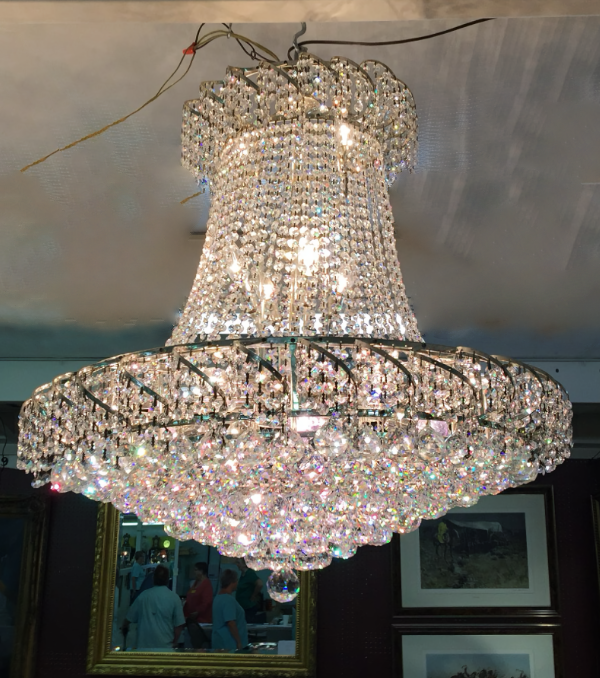
As someone who was born in the Florence Crittenden Home for Unwed Mothers in Sioux City, IA, adopted by a wonderful farm family from southwestern Iowa, served in the U.S. Army, served 12 years as a U.S. Congressman, spent 14 years making the world a safer place through a company named Forensic Technology and some 19 years in commercial broadcasting. Life has been good.” He added, “I’ve reached that age where I don’t even buy green bananas. I don’t get around as well as I once did, and I shake my head at the changes I have seen in our world. I mark my experiences as a farm broadcaster at the top of the list of good things that have happened. Today, time is spent reading a good book, writing an occasional op-ed, fixing up an old chandelier for my wife to sell in her antique business or just sitting and scratching the dog. And that, my friends, is pretty much what an old farm broadcaster does.”
Jim’s wife Nancy deals in antique elegant glassware and crystal. “I’m not elegant but I do qualify as antique.” In attending various sales, it became apparent that some of these old houses had some very beautiful chandeliers. So, a unique hobby evolved. “We have to take the chandeliers down and then they go to my shop. The first thing I do is check the wiring as these fixtures are very old and many of them have unsafe wiring. Once the wiring is made safe the cleaning process starts. For the most part, these fixtures have hung for many years without anyone paying attention to them. To say they are dirty is an understatement.” In many cases it means removing all the crystals from the fixture and washing them separately. It’s not uncommon to have more than 300 crystals on one fixture. “Each one is painstakingly cleaned by hand and then reassembled. At times, I have to find replacement crystals for those that have been lost or broken. Although it is time- consuming work, there is much pleasure in seeing an old antique chandelier come back to life.”
Jim’s start in radio
Jim’s start in radio came as a result of his friendship with Jim Hartz (later became host of the Today Show) and Milt Haynes (CBS overseas reporter), who both worked at KRMG Radio in Tulsa, OK, when Jim was a police officer there.
Did Jim and Milt do something specific that moved you to radio ?
I saw this guy walking in one of the poorer neighborhoods every morning at about 1:30–1:35 AM. He was not doing anything wrong, so I had no particular reason to stop or investigate him. However, to me, it seemed strange that this tall man was walking in a dark, high-crime, poor neighborhood at 1:30 AM night after night.
One cold night, I pulled over and had him get in the car. I asked him to explain this unusual habit of his. I learned he was Milt Haymes from KRMG radio, and he was signing the station off the air at midnight and then walking home. His route through this tough area was about 20 blocks shorter than taking the safe route under the streetlights. Over time, we became friends, and I started spending some of my time off at KRMG, where I met and became friends with Jim Hartz. The three of us became good friends and spent much time together.
They convinced me I had a good voice for radio. When it came time for me to leave the Police Department, Milt told me about an ad he had seen in one of the publications designed for the radio business. So off I went to Colorado Springs and KSSS radio. They wanted a newsman and someone who could also be a DJ. There was only one problem for me: I had never been a broadcaster.
They were looking for someone to fill the position. Bob Manser was the program director. He handed me a bunch of copy and took me into the studio. There are several streets, communities, and other places with Native American names in the area. He said no one not from the area could pronounce them, so I received a quick lesson. I sat down at the little table with a microphone, and Bob went into the accompanying control room and pointed at me to begin reading the news. This was the first time I had sat in front of a microphone and was asked to read the news. Without a doubt, this was the most nervous I have ever been. Ten minutes later, it was over. I told myself, “Yes, it’s done, and I don’t think I blew any words!”
Before I could get my nerves calmed, as this audition was over, Bob took me into another studio filled with equipment. “Okay,” he said, “now we are going to see what kind of a DJ you are.”
“What?” I had never played a record or used one of those tape machines that were used in those days to play commercials. Bob handed me a pile of records, several little reels of tape with commercials on them, and an extra page off the day’s program log.
The old brain kicked in, and I started to remember many of those days spent with Milt and Jim in the KRMG studios when they were on the air. The turntables looked the same. The control panel was different, but the knobs and switches to use were obvious, as the wear patterns in the paint on the panel indicated the most-operated switches. That told me which switch to use.
I only goofed up once, and it went pretty well. If I had not spent those hours with Milt and Jim while they were on the air, this would have been the end of my radio career before it even started. And then Bob said, “Take a seat in the waiting area, and I will play these tapes for the boss.” “For the boss!” flashed through my mind. I had no idea Bob had recorded the entire session. I thought Bob was making the decision as we were doing the audition. He had been jovial while we were doing it, so I had the idea that maybe I would get the job. But now the boss. Oh boy. Where are the keys to the car?
About 15 minutes later, Bob came down the hallway, put out his hand, and said, “When can you start? The boss really liked your audition.” I was in the radio business!
Three years later, the station was sold, and the new owner automated it. All he needed were a couple of engineers; the rest of us were out the door.
I found a new job with a country music station in Denver once the automation was completed. I had a week of vacation I had not taken. Starting a new job, it was going to be at least a year before I could get home. The weekend I left on Sunday to go back to Colorado, the Southwest Iowa Little Theatre Group was presenting a play. I went on Friday night.
During a conversation with a KMA announcer I knew who was acting in the play, he told me there was a position opening up because one of the KMA people was moving to a station in Omaha. We met the next morning at the KMA studios and recorded a tape my friend said he would pass along to Program/News Director Dean Naven on Monday.
Bright and early Sunday morning, I headed back to Colorado. Thursday afternoon, the phone rang just as I finished the news. It was Dean Naven, and he offered me a job at KMA. I said yes, and Dean asked, “I want you here Monday morning. Can you make it?”
Whoa. Much was happening very rapidly. I told Dean I would be there.
Saturday night, I signed off the air at midnight, bid KSSS goodbye, rode the elevator down to the parking lot area, got in my packed car, and headed east. Five hundred eighty-eight miles and eleven to twelve hours should get me to the folks’ place on Manti Road, just east of Farragut. Great, I would have most of Sunday afternoon and night to get rested up before the new job at KMA Monday morning.
When I hit the Kansas line, it started to snow. The farther east I got, the harder it was snowing. The road was getting hard to drive on, and the thought went through my mind that I might be spending the night out here in the plains of Kansas. Hopefully, a snowplow would find me. Then I hit a small town with a truck stop. There was a snowplow parked near the café door. I needed a cup of coffee, so I pulled in beside the snowplow truck and parked. Walking into the café, it was obvious who the driver was, and there was an empty seat at the counter beside him. He explained that it was worse the farther east a person went. He was going to plow about two hours and then turn around and come back on the other side of the highway. Another driver would be plowing the next stretch, and so on until the end of the blizzard area was reached. An invitation to follow close behind him was offered, and we hit the road. At the end of his run, it was a one-hour wait for the plow to come in from the opposite direction. He took a break and had lunch. Finally, back on the road again, we sped onward across Kansas at a neck-breaking speed of 15 to 20 MPH.
The sun finally decided it had watched enough blizzard and went to bed. An hour or so after that, the east side of the blizzard was reached. A few more hours and the gentle crunch of the gravel in the driveway of the farmhouse on Manti Road. The ordeal was over, and I had a little less than three hours to rest before reporting in at KMA.
And as the old saying goes, “The rest is history.”
Dwight Durfey