Evolution of Education
The Evolution of Education in Farragut
Long before the C. B. & Q. Railroad (named Burlington and Missouri at that time) between Red Oak and Hamburg was completed in the summer of 1870, and William Hall was appointed as a section foreman to maintain the “iron road” was assigned to an area in Fisher Township that became known as Lowland (later changed to Farragut), decisions that would impact education in Farragut had already been enacted.
The Land Ordinance of 1785
In the Northwest Ordinance of 1785, the US Congress declared that western lands would be under the authority of the federal government, not westward extensions of the existing states. The Ordinance set up federal support for public schools in the west before there was support for universal free education in the original states.
The ordinance set up a survey system that eventually covered over three-quarters of the area of the continental U.S., including what became the state of Iowa.
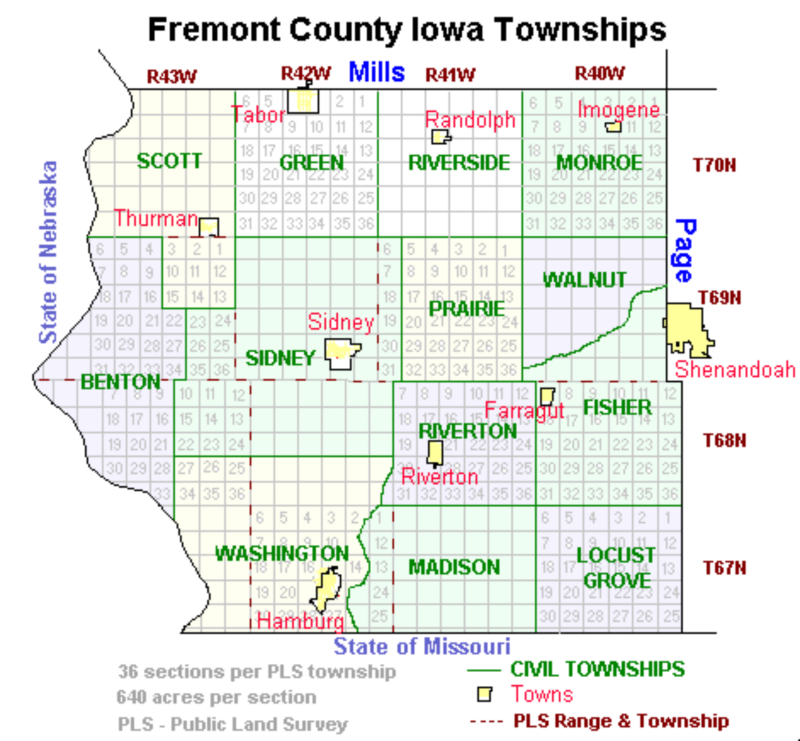
It created the now-familiar pattern of square townships, six miles on a side, each divided into 36 sections of one square mile or 640 acres. The Land Ordinance contained the first recorded use of the terms “township” and “section” in terms of land surveying.
The other significant provision of the Land Ordinance of 1785 was its requirement that Section 16 of each township, located in the township’s center, be reserved for the maintenance of public schools. The farm proceeds from that section could be used for the expenses of maintaining the township’s schools, which usually numbered nine per township.
The original public land survey of Iowa was conducted by the General Land Office (GLO) between 1832 and 1859. The bulk of the frontier townships and mapping sections, including Fremont County, were largely finished by 1852. The survey of Fremont County established a total area of 517 square miles (511 square miles of land and 5.5 square miles of water) and created 13 Townships.
The Territory of Iowa was officially created by Congress on June 12, 1838 and went into effect on July 4, 1838. On December 28, 1846 – “An Act for the Admission of the State of Iowa into the Union” was signed by President James K. Polk, making Iowa the 29th state to join the Union.
Fremont County:
Following the 1837 Platte Purchase, the area was settled by pioneers, traders, and farmers, with early non-native settlements often referred to as "French Village" near the Nishnabotna River.
Established in 1847 and officially organized in 1849, Fremont County, Iowa, in the southwest corner of the state, was named for explorer John C. Frémont.
Sidney was established as the county seat in 1851.

The 13 Townships of Fremont County, in compliance with the mandate of The Land Ordinance of 1785 regarding public education, created numerous country schools to serve their student populations. For the most part, these were one-room wooden structures, distributed throughout the nearby area in proximity to the school age children living on farms. Typically one teacher taught multiple subjects to students of various ages and grade levels.
These schools were the responsibility of the townships in which they were located.
The Townships of Fremont County with the number of schools:
Scott 11 schools 41.52 sq. miles
Green 15 schools 34.42 sq. miles
Riverside 7 schools 35.96 sq. miles
Monroe 10 schools 35.92 sq. miles
Benton 11 schools 45.71 sq. miles
Sidney 24 schools 73.40 sq. miles
Prairie 9 schools 29.75 sq. miles
Walnut 7 schools 25.20 sq. miles
Washington 14 schools 51.24 sq. miles
Riverton 6 schools 29.25 sq. miles
Fisher 8 schools 40.45 sq. miles
Madison 7 schools 39.41 sq. miles
Locust Grove 7 schools 31.15 sq. miles
*136 schools throughout the 517 sq. miles of Fremont County
( average of a school every 3.8 miles )
The Manti Community in Fisher Township, Fremont County, Iowa, was an early pioneer settlement established in 1852 by Alpheus Cutler and his followers, who broke away from the Church of Jesus Christ of Latter-day Saints. Originally located in the Lower Nishnabotna River Valley, it became the first town founded in the county and operated its first log school in 1853.
The presence of the railroad supported growth in commerce and population in Farragut and the surrounding area. In 1873, just three years after its founding, Farragut’s first school building, a one-room frame structure, was erected on the site now occupied by the Dale Gudgel residence.
In 1880, the independent district of Farragut was set off from Fischer township at the March meeting of the school board. The township gave the town the old No. 6 schoolhouse and $1,500 as dower. The new district held its first meeting on April 10.
It took steps to erect a new schoolhouse.
Described as the “very best school building around”, a two-story, brick 30’ x 50’ foot building was constructed for $4,700. It had a 10-foot by 40-foot entrance and hallway. This school was located at Tecumseh Ave and Clay St, two blocks north of the first school building constructed in 1873 (one block north of the Congregational Church).
(In 1909, a two-story addition was added to this structure.)
State of Iowa Superintendent of Public Instruction Henry Sabin recommended in 1895 the revolutionary idea of publicly supported transportation. In 1898 Dean Amos N. Currier of the University of Iowa recommended “reorganization” under the township as the administrative unit. Central graded schools should be made available to all rural children with transportation at public expense.
Currier’s ideas launched a movement for consolidated schools. (In 1895 Buffalo Township voted to form a Town Independent District around the village of Buffalo Center. Students were “bused” on six horse-drawn wagons called “hacks” into town for their education. This action led to the formation of the first consolidated school district west of the Mississippi River.
Iowa first enacted a compulsory education law in 1902, requiring children ages 7 to 14 to attend school, generally within their home district. While the law required attendance in "some public, private, or parochial school," it inherently implied residency in the district or authorized exemption, with stricter enforcement and residency rules evolving alongside school consolidation in the early 20th century.
Although the first consolidation law in Iowa was passed in 1906, the movement was slow getting started. The law mandated that a school district include no fewer than sixteen square miles; and electors in both urban and rural areas had to approve the larger district in separate votes.
In 1908, State Superintendent John Franklin Riggs advocated county-wide planning of larger schools and better transportation. He also campaigned for the standardization of teacher certification under the control of the state. By 1910, there were only ten consolidated schools.
The consolidation movement began to end around 1919. The disruption of food production in Europe during World War I led to higher prices for American crops. Higher crop prices led to higher prices for farmland, but American farmers were encouraged to expand their holdings. In the fall and winter of 1919, crop prices began to fall. There was no decline, however, in the cost of farm implements, the price to haul products to market, or the debt they had to the bank for their loans to purchase land. School consolidation had increased costs to Iowans who had to pay for buses to transport children and higher wages for teachers. The increased use of buses and automobiles led to the need for better roads. Taxes were increased at a time when many could not afford them.
“1920 – The January election carried to consolidate the Farragut School District. Contracts were let to Thomas McMahon, Jr., at $185 per month; Lester Burdick, $175 per month; and B. G. Phillips, $175 per month to furnish trucks to transport the children to school from rural districts.”
It was cheaper to maintain the elementary school in the country and pay the tuition to the nearby town or consolidated school for those who wanted to continue their education.
Beginning in the 1920s, many of the Township-operated country schools in Fremont County closed and students were transported to a school in one of the independent school districts. For most of the country school students located near Farragut, their proximity to the Farragut School made this decision easy. The creation and enforcement of school district boundary maps was a new subject for school administrators and would continue to be complicated issue for years to come.
In 1922, Iowa legislation specified that it be “the policy of the state to encourage the reorganization of school districts into such units as are necessary, economical and efficient and which will insure an equal educational opportunity to all children in the state.”
“1926 - As the district grew, a two-room building for grades 1 and 2 was erected at 1108 St Phillip Ave (one block east of the school built in 1880). It was first occupied in October 1926 and was used for three years.”
“1928 - The Farragut School Board petitioned to call an election for consolidation of the school district, and to vote on a proposition of issuing bonds in the amount of $75,000 for purchasing the new schoolhouse site and erecting a building thereon. On March 12, the bond issue was voted upon; it carried by a vote of 225-170. Nelson and McMurray, Council Bluffs, were awarded the contract.” This new schoolhouse was first occupied in March 1929.
Country schools continued to close over the years and on December 30, 1943, there were only 53 rural schools in Fremont County. The average yearly salary of these teachers was $895.50.
In 1953, Iowa school law was changed to require each of the non-high school districts to join with a high school unit by 1962. New districts were to have at least three hundred students in kindergarten through grade 12. The new community school district would decide whether it would continue to use the one-room schools in the joining districts.
When legislation was passed in 1955 that all country school would close by June 1, 1966, fifty new community school districts were formed. The 1958-1959 school year saw the greatest number of consolidations when 829 districts merged into 102 new school units that had to transport children.
In 1957, County Superintendent Wayne Drexler announced that the first phase of school reorganization—initiating detailed studies and surveys of school districts within the county and the adjacent territory—was about to begin. The 57th General Assembly had passed a reorganization law that required all public-school districts had to be a part of a public district that maintained twelve grades. If an area were not in such a district by that time, it would be placed in one.
In 1959, Sunny Slope School and Honey Creek School, both in Monroe Township, became the last Fremont County country schools to close.
Reorganizations effective July 1, 1959 included:
Farragut - ( Farragut - Imogene )
Fremont-Mills – ( Tabor - Bartlett – Randolph – Thurman )
Shenandoah – ( Shenandoah - Northboro )
South Page – ( College Springs - Blanchard – Braddyville – Coin )
Imogene Public School consolidated with Farragut in 1959
Grades 9-12 came to Farragut that fall but the lower grades remained in Imogene until the 1964-65 school year. Teachers remaining in the Imogene School were: Geraldine Laughlin; Crystal Williamson; and Lela Hoy.
Imogene St. Patrick Academy High School consolidated with Farragut in 1961 The senior class that graduated in the spring of 1961 was the last to graduate.
High school students began attending Farragut when school began in the fall of 1961.
In 1962, the General Assembly passed legislation that allowed the state to assign any unattached district to a high school district by 1967. There were only 46 non-high school districts by 1966, and only 19 districts remained to be assigned in 1967.
Riverton High School consolidated with Farragut in 1963
The senior class that graduated in May 1963 was the last for Riverton High School. When the school year began in August 1963, Riverton high school students began attending school at Farragut High School. The Farragut High School graduation in May 1964 was the first to include students consolidated from Farragut, Imogene, and Riverton.
In the fall of 1964, elementary teachers Evelyn Mather, Zoe Young, Araruth Nihart, and Daphne Holliman continued to teach students from Farragut, Imogene and Riverton who attended school in the Riverton building. Pat Elliott served as the school nurse.
Imogene St. Patrick Parochial School consolidated with Farragut in 1969
St. Patrick Parochial School closed at the end of the 1968-69 school year. Grade school students began attending Farragut when school began in the fall of 1969.
The Riverton school house continued to be utilized for elementary students from Riverton, Farragut, and Imogene until the end of school in the spring of 1980.
In May 2011, the last class graduated from Farragut Community High School.
Nishnabotna Junior-Senior High School
This was a secondary school in Farragut, Iowa. It was operated by the Farragut Community School District in association with the Hamburg Community School District. It opened in the fall of 2011 and closed in May 2016. The school served the communities of Farragut, Imogene, and Riverton in the Farragut district and Hamburg in the Hamburg district. Its mascot was the Blue Devil.
It was established after the Farragut and Hamburg school districts agreed to do a "grade-sharing" arrangement in which students from one district attended another district for certain grade levels so the two could save resources.
Initially Nishnabotna received the senior high school students in both districts. In 2015 the grade-sharing arrangement was changed in which all levels of secondary students, middle and high, went to Farragut, and therefore, Nishnabotna.
Beginning in 2011, the Farragut and Hamburg districts jointly used the name Nishnabotna Community School District, although the district never legally existed. A vote to legally consolidate the Farragut and Hamburg school districts into a single Nishnabotna Community School District failed when the Hamburg residents voted it down on a 271-264 basis, while Farragut residents had approved it on a 371-32 basis.
In 2015 the Iowa state government agreed to dissolve the Farragut district, and therefore, Nishnabotna High, effective 2016.
The Farragut school closed in May 2016.
Summary
The 1906 legislation laid the groundwork for decades of continuous educational reform in Iowa. It paved the way for subsequent legislation—most notably in the 1950s and 1960s—that mandated all areas of the state become part of a legally-constituted school district maintaining a high school.
Iowa school consolidation significantly reduced school districts from over 13,000 in the late 19th century to 338 in 2014-2015 and to 325 in 2026. Driven by legislation in the 1950s that required K-12 districts, the process eliminated thousands of one-room schoolhouses. Key drivers included economic efficiency, urban migration, and improved rural education quality.
The final phase of the community school movement came in 1965, when the 61st General Assembly passed legislation requiring all areas of the state to become part of a legally-constituted school district maintaining a high school by July 1, 1966. This law mandated the closure of all public rural one-room schoolhouses.
Why Consolidations Occur
Declining Enrollment: Shrinking rural populations and a steady movement of families toward urban centers force smaller districts to combine to remain viable.
Funding: State aid is allocated on a per-student basis. Consolidating pools resources, making it more affordable to offer a wider variety of classes, athletics, and extracurriculars.
State Standards: Legislation historically mandates that districts provide a continuous K-12 education, pushing smaller, localized areas to merge.
Pros and Cons
Proponents argue mergers lead to enhanced educational opportunities, better facilities, and stronger course catalogs.
Critics point out that the process can destroy local community identity, eliminate personalized attention, and burden students with long bus rides (state law currently restricts one-way bus travel for students to one hour).
School districts in Iowa can cross county lines, and many do. School district boundaries are entirely separate from county or township lines and are determined by the needs of the community and Area Education Agencies (AEAs) rather than political county borders.
*****
During Orin Mann’s tenure as superintendent (1945-1966), he led the school through a period of significant change. Community growth, increased student population, selection and hiring of quality teachers, curriculum and activities enhancements, facilities expansion planning with successful ballot initiative, and management of State of Iowa mandated actions in support of school consolidations. He also served as the head coach of the girls’ basketball team. In 1951, for just the third time in school history, the team qualified for the State Tournament in Des Moines. He led them back to Des Moines again in 1952 and 1954.
A former member of the administrative staff told me of all of Orin Mann’s success and accomplishments, one of his proudest was the adoption and implementation of the 137 square mile school district map when it was completed (date uncertain).
*****
In my research of this subject, I have interviewed former teachers and administrators; personal classmates and fellow students; and some folks I knew only by name. It occurred to me that I would have had more resources available to me had I undertaken this project some years ago – and in that there is a valuable lesson. I leaned on Google to dig deeper into US history, State of Iowa and Fremont County documents.
Farragut school yearbooks continue to be both valuable and entertaining for brushing up on school history and memories.
“The Farragut Centennial History Book 1870-1970” produced by the Farragut Community Club and the “Southwest Iowa Heritage – A History of Page and Fremont Counties Bicentennial Edition”, should always be utilized when researching Farragut history.
Research documents even include an article published in the July 8, 1959, edition of the Omaha World-Herald which was discovered under the linoleum floor covering in a room of the Farragut Hotel (a source no doubt deserving an explanation).
Researching history can be a tricky thing. I am comforted in knowing that readers will let me know if I got something wrong.
*****
At the conclusion of my research, I am left with this unanswered question:
What year did Imogene area students begin attending school in Farragut?
As documented, the Imogene Public School consolidated with Farragut in 1959.
When school ended in the spring of 1959, the Imogene Public School closed and the students attended school in Farragut when school started in the fall of 1959.
Prior to this consolidation, students residing in Imogene, both in town and rural, were allowed to attend school in Farragut. FHS ’42 graduate Arlene (Wetherell) Phipps lived in Imogene and attended school in Farragut.
“Imogene became a part of Farragut School District in 1941, and Riverton in 1964, forming Farragut Community School District”
Source: “Thumbprints in Time” – Fremont County, Iowa 1996 (author unknown)
*I know an individual who lived a few blocks from the Imogene Public School and graduated from Farragut in 1942. This was before the 1959 consolidation with Farragut.
Apparently “school choice” existed much earlier than I thought.
Submitted for your reading pleasure – Dwight Durfey, FHS Class of 1971