The Evolution of Education in Farragut
Long before the C. B. & Q. Railroad (named Burlington and Missouri at that time) between Red Oak and Hamburg was completed in the summer of 1870, and William Hall was appointed as a section foreman to maintain the “iron road” was assigned to an area in Fisher Township that became known as Lowland (later changed to Farragut), decisions that would impact education in Farragut had already been enacted.
The Land Ordinance of 1785
In the Northwest Ordinance of 1785, the US Congress declared that western lands would be under the authority of the federal government, not westward extensions of the existing states. The Ordinance set up federal support for public schools in the west before there was support for universal free education in the original states.
The ordinance set up a survey system that eventually covered over three-quarters of the area of the continental U.S., including what became the state of Iowa.
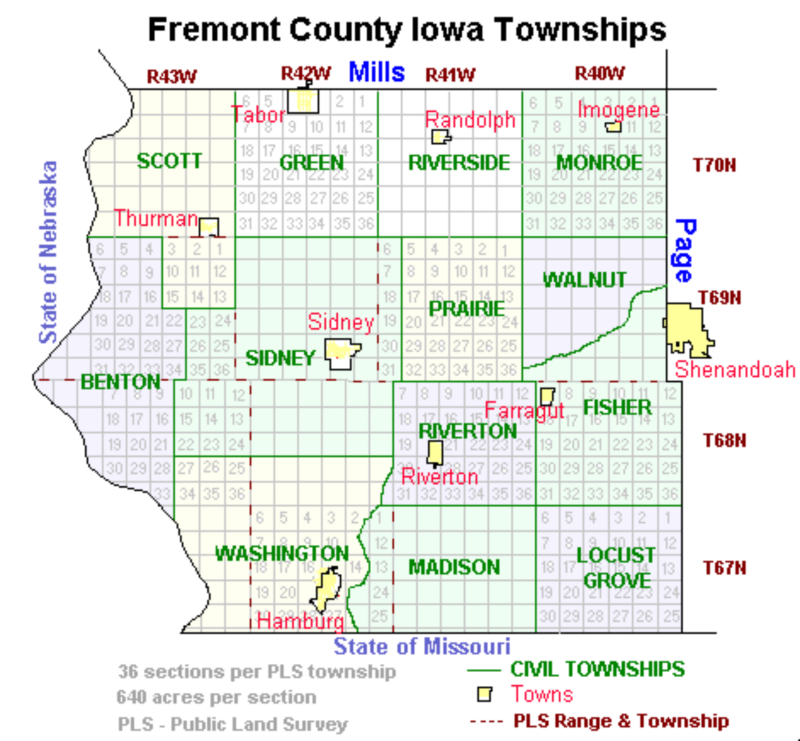
It created the now-familiar pattern of square townships, six miles on a side, each divided into 36 sections of one square mile or 640 acres. The Land Ordinance contained the first recorded use of the terms “township” and “section” in terms of land surveying.
The other significant provision of the Land Ordinance of 1785 was its requirement that Section 16 of each township, located in the township’s center, be reserved for the maintenance of public schools. The farm proceeds from that section could be used for the expenses of maintaining the township’s schools, which usually numbered nine per township.
The original public land survey of Iowa was conducted by the General Land Office (GLO) between 1832 and 1859. The bulk of the frontier townships and mapping sections, including Fremont County, were largely finished by 1852. The survey of Fremont County established a total area of 517 square miles (511 square miles of land and 5.5 square miles of water) and created 13 Townships.
The Territory of Iowa was officially created by Congress on June 12, 1838 and went into effect on July 4, 1838. On December 28, 1846 – “An Act for the Admission of the State of Iowa into the Union” was signed by President James K. Polk, making Iowa the 29th state to join the Union.
Fremont County:
Following the 1837 Platte Purchase, the area was settled by pioneers, traders, and farmers, with early non-native settlements often referred to as "French Village" near the Nishnabotna River.
Established in 1847 and officially organized in 1849, Fremont County, Iowa, in the southwest corner of the state, was named for explorer John C. Frémont.
Sidney was established as the county seat in 1851.