

Last Man’s Club Banter Fading

(back row far right is James Alpheous ‘Al’ Davis)
Last Man Club 1974 Reunion in Shenandoah, IA
(Front row- left to right)
Herbert Peterson Pine, AZ
Floyd Roberts Jan 31, 1898 – Jan 15, 1991 Farragut Iowa Cemetery
Everett Ilo “Dutch” Briggs Jan 31, 1898 – Jan 15, 1991 Shenandoah Rose Hill Cemetery
Frank Crouch Midwest, OK
George Harold Johnson Sr. Mar 2, 1893 – May 8, 1982 Essex Cemetery
Allen Sirles Atlanta, GA
(Back row – left to right)
Laurence Edward Livingston Oct 6, 1899 – Dec 12, 1992 Farragut Iowa Cemetery
Vernie Russell McCunn Apr 4, 1893 – Feb 17, 1976 Shenandoah Rose Hill Cemetery
Ralph Sullivan Golden, CO
William L. (Bid) Beck Dec 12, 1899 – Nov 22, 1988 Blanchard Iowa Cemetery
James Alpheous “Al” Davis Sr Nov 19, 1894 – Mar 21, 1985 Farragut Iowa Cemetery
Attended reunion but not in picture:
Harry A. Selfe 1898 – 1982 Shenandoah Rose Hill Cemeter
Last Man’s Club Banter Fading
by Chuck Offenburger – Des Moines Staff Writer
Shenandoah, IA (1974)
They still gather here, mere husks of the men they were when they fought through France in 1918 as members of Shenandoah’s Company E, a part of the famed 42nd Rainbow Division.
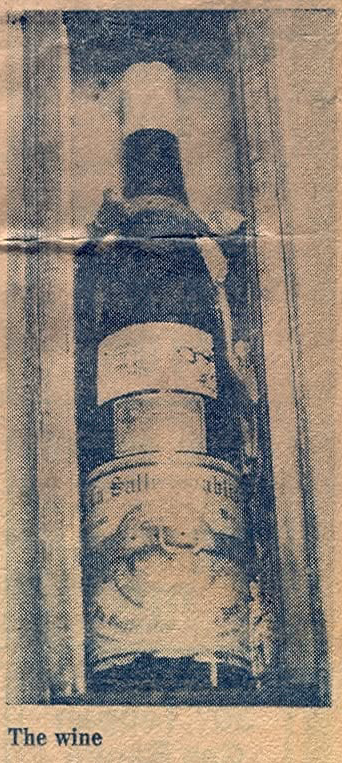
They pass, for inspection only, a bottle of wine they say has long-since turned to vinegar. It’s to be consumed by the last of their number.
“There used to be a lot of bantering about who’d get it,” says Dutch Briggs, 76, former platoon sergeant. “I haven’t heard any of that in the last five or six years.”
They kid that no one wants to drink a bottle of vinegar. What they mean is that no one would want to drink it alone – even if it were still good wine.
They’ve even considered letting the last two men split it. The problem in this Last Man’s Club is that, near the end, no one really wants to be the last man.
The company lost 63 men at Champagne, Chateau-Thierry, Sergy, Saint-Mihiel, and Meuse-Argonne, and 142 were wounded. “It was pretty rough,” Briggs said.
Now, 56 years after the Armistice, it’s again pretty rough for the men of Company E. They fall, in old age nearly as fast as their buddies fell in service against the Hun.
Liberty Pease
Liberty Pease, the unit’s hero, decorated five times, is gone. They say he was the fightingest man in the company, that he didn’t have enough sense to fear death in the trenches of Europe.
His quite common and unheroic death in a Veterans Administration hospital years later was no measure of the valor that distinguished him from his peers in World War I.
Captain Clyde H. Doolittle commanded the company during much of the fighting: decades later, his men still respectfully refer to him as Captain rather than Clyde.
But he’s dead too.
So are 144 others who came home from the war with Company E.
There are 53 known survivors scattered all over the country – 18 of them over 80 years old, the rest over 70.
Some answer the yearly call to reunion here, some write their regrets, some don’t even respond. Those who attend officially pare the roster, as they did a week ago. Six more dead since the 1973 reunion, nine in the year before that.
“There’s no morbidity to it,” says Briggs, who organizes the reunion and maintains the records. “I announce the deaths and we observe 30 seconds of silence. Then we go on and have a good time. You can’t live in the past. You can’t wear grief on your sleeve.”
Though the agendas for the reunions have been the same since the first one was held in 1934, what actually takes place has changed considerably.
“We’ve always had an early-bird party the night before the actual meeting.” Briggs said. “Anymore the birds aren’t so early. But I remember some of those things going all night long. There was a lot of war talk. The guys couldn’t even see their wives they were so busy talking. They’d get into great arguments about what happened where during the war. In the past few years, the talk has mostly been families and retirement.”
He reported in the minutes of the 1971 meeting, that things were “much quieter with less moving around and more just sitting.” Waitresses report Company E can now hardly dent a modest buffet dinner.”
The number attending the reunions has dwindled from the all-time high of 46 several years ago to the low of 12 at the 1974 meeting, not counting the wives and widows who attend.
“It’s a mystery to me,” says Briggs, “why we’ll have some guys come from the coasts at considerable expense, and then we’ll also have guys within walking distance who won’t attend.”
Clarence Kier is one of the local members who’s quit attending. “A feller gets some age on him,” Kier says, “and he just doesn’t care to get with a bunch of guys. Everyone is getting so old they have to be introduced to each other all over again. I don’t feel the togetherness.”
They wondered at the 1974 meeting, as they have at the last several, what will happen to the club when Dutch Briggs dies. They wondered like that until Dutch admonished them that wondering was silly, what with the press of other business. So for another year, they eyed each other and figured “someone would keep it going.”
Then they read the letters from absent members. “The letters get you pertneer wiping the tears away,” Dutch said.
And they passed the bottle of wine that’s labeled:
“Yours to look at,
But not to have
Until the end
Of the Rainbow.”
George Johnson, 81, of Essex, says whoever ends up with it will probably find “it’s not much good ‘cept to put on lettuce.”
Al, dressed in his WWI Army uniform and Alice wearing a dress and bonnet from that time period, these former Farragut residents are seen in this picture as they prepared to participate in the 1970 Farragut Centennial celebration.
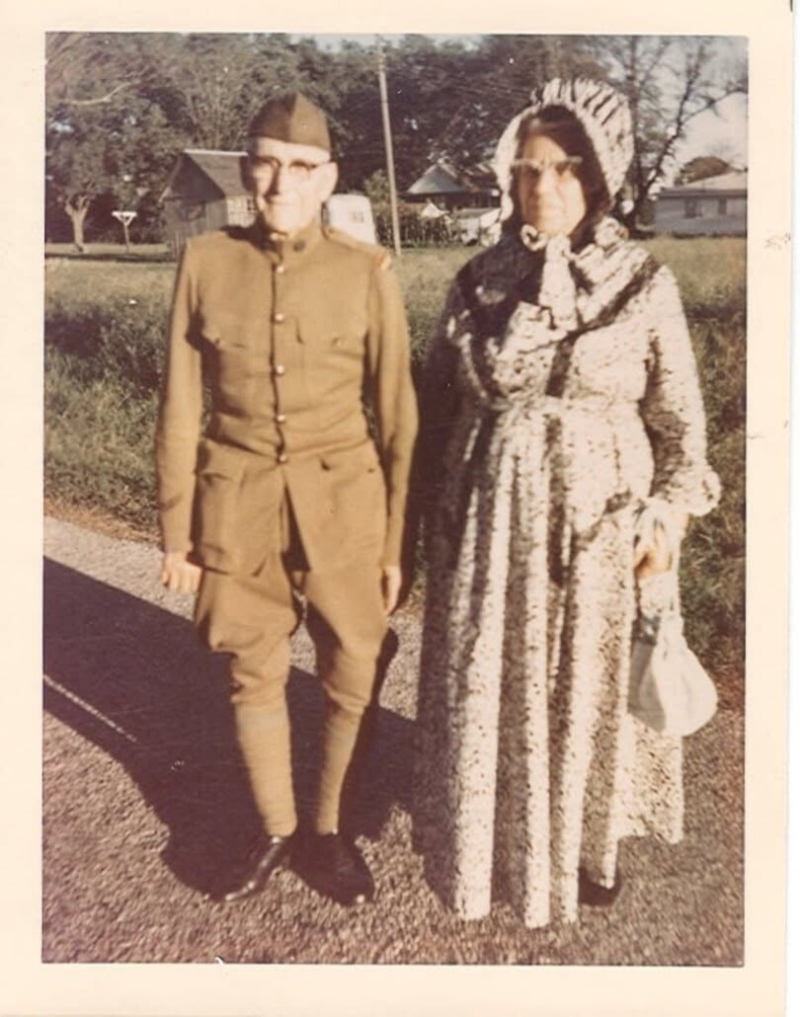
James Alpheous ‘Al’ Davis (1894-1985) and his wife
Alice Dorothy (Livingston) Davis (1901-1971)